6 Tactics to Raise Capital from Family Offices (What Actually Works)

A practical guide for emerging fund managers on how to raise capital from family offices, covering research, outreach, relationship building, and closing strategies.
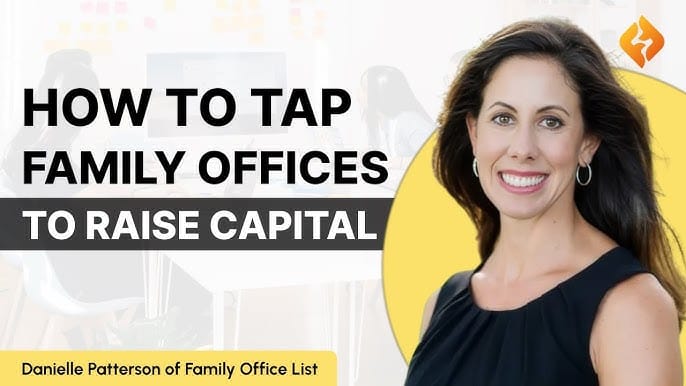
How to Raise Capital from Family Offices: A Guide for Emerging Fund Managers
Family offices are one of the most sought-after sources of capital for emerging managers.
They’re flexible. Long-term oriented. Often more open to backing new managers than institutions.
But they’re also one of the hardest investor groups to navigate.
As Danielle Patterson explains, the space is “very fragmented… even for the family offices themselves.”
There’s no standard process. No uniform behavior. No single playbook.
That’s exactly why most managers struggle.
Here’s a more practical way to approach it.
1. Start with Research, Not Outreach
The biggest mistake managers make is treating family offices like a list.
Download contacts. Send emails. Hope something lands.
That approach rarely works here.
Family offices are highly individual. Each one has:
- Different investment preferences
- Different structures
- Different decision-makers
- Different motivations
As Danielle emphasizes, “there is no one-size-fits-all.”
That means your edge comes from preparation.
Before reaching out, you should know:
- What they invest in (stage, sector, geography)
- Whether they invest in funds or direct deals
- Who actually makes the decision
- What the family cares about (themes, values, legacy)
It’s the baseline.
What to do:
- Build a tight, high-quality list (25–75 targets)
- Prioritize relevance over volume
- Write down why each one is a fit before reaching out
Lesson: Precision beats scale when targeting family offices.
2. Treat It Like a Long-Term Relationship, Not a Fundraise
Many managers approach family offices like transactional LPs.
Pitch → Follow-up → Close.
That framing doesn’t work well here.
Family offices think differently.
They are not just allocating capital. They are:
- Preserving wealth across generations
- Building long-term partnerships
- Looking for aligned people, not just returns
Danielle puts it simply: approach it as a partnership, not a “quick check.”
This changes your posture entirely.
You’re not just asking:Can you invest?
You’re showing:Why does this relationship make sense over time?
What to do:
- Share ongoing updates, not just a pitch
- Frame conversations around alignment
- Show how your strategy evolves, along with where it is today
Lesson: Family offices invest in people and relationships before they invest in funds.
3. Warm Familiarity Beats Cold Outreach
Cold outreach can work.
But it’s rarely the most effective path with family offices.
They receive a high volume of inbound. Most of it looks the same.
What cuts through is familiarity.
Danielle recommends building that through lightweight touchpoints first:
- Connecting on LinkedIn
- Engaging with their content
- Showing support before asking for anything
This creates recognition.
So when you do reach out, you’re not starting from zero.
She references a simple idea: “show me you know me.”
That’s the difference between:Generic outreach vs relevant outreach
What to do:
- Engage before reaching out
- Reference something specific about the family office or the people behind it
- Explain why you're reaching out to them specifically, rather than sending the same message to every investor
Lesson: Familiarity lowers friction more than a perfectly written cold email.
4. Use Multi-Channel Access, Not Just Email
One of the biggest unlocks with family offices is access.
Email alone is limiting.
Many family offices:
- Are small teams
- Don’t have structured inbound processes
- Don’t actively respond to cold outreach
That’s why conferences matter more here than in most asset classes.
Danielle highlights this clearly:
Being “in the right room” is one of the most effective ways to build real connections.
But not all events are equal.
Smaller, curated events tend to work better than large conferences where it’s harder to connect.
What to do:
- Prioritize family office-focused events
- Target smaller, high-quality gatherings
- Follow up immediately after meeting in person
Examples mentioned include:
- DC Finance
- Opal Group
- Family office-focused niche events
Lesson: Access is often earned offline before it converts online.
5. Lead with Value, Not Just the Ask
One of the most overlooked ideas in fundraising is value exchange.
Most outreach looks like this:Here’s my fund. Can you invest?
That’s incomplete.
Family offices are looking for ways to:
- Extend their capital
- Access expertise
- Enter markets they don’t know
Danielle frames this clearly.
The strongest positioning is:Here’s how together this opportunity becomes stronger.
That might be:
- Your expertise in a niche market
- Your access to unique deal flow
- Your ability to execute where they can’t
What to do:
- Be explicit about your edge
- Show how you complement their capabilities
- Position yourself as a partner, not just a capital user
Lesson: Capital is one input. Show why you’re the multiplier.
6. Understand the Differences Within Family Offices
Not all family offices behave the same.
Two important distinctions:
Single Family Office
- Represents one family
- Often values-driven
- Easier to align around specific themes
Multi-Family Office
- Manages capital for multiple families
- More structured
- Often more return-oriented
Your approach should reflect that.
With single-family offices:
- Lean into values and alignment
With multi-family offices:
- Lean more into track record and structure
Also, decision-making varies widely.
You might be speaking to:
- A family member
- A next-generation operator
- A professional investment manager
Each requires a slightly different approach.
Lesson: There is no “family office strategy.” There are many.
Final Thought
Raising from family offices is not faster.
It’s not easier.
But it can be more durable.
Relationships take time. Sometimes years.
As Danielle notes, “it’s never too early to start… plant the seed now.”
The managers who succeed here don’t treat it like a sprint.
They treat it like compounding.
Over time, that becomes an advantage.
And in a fragmented market like this one, that’s exactly what you need.
If you're ready to start researching family offices, Fundingstack provides access to 3,000+ family offices along with tools to help emerging managers build and manage a more targeted fundraising pipeline.