Inside Venture Studios: How the Model Works and What VCs Need to Know

Matthew Burris explains how venture studios works, how they support founders, and what VCs should know before investing in studio-backed startups.
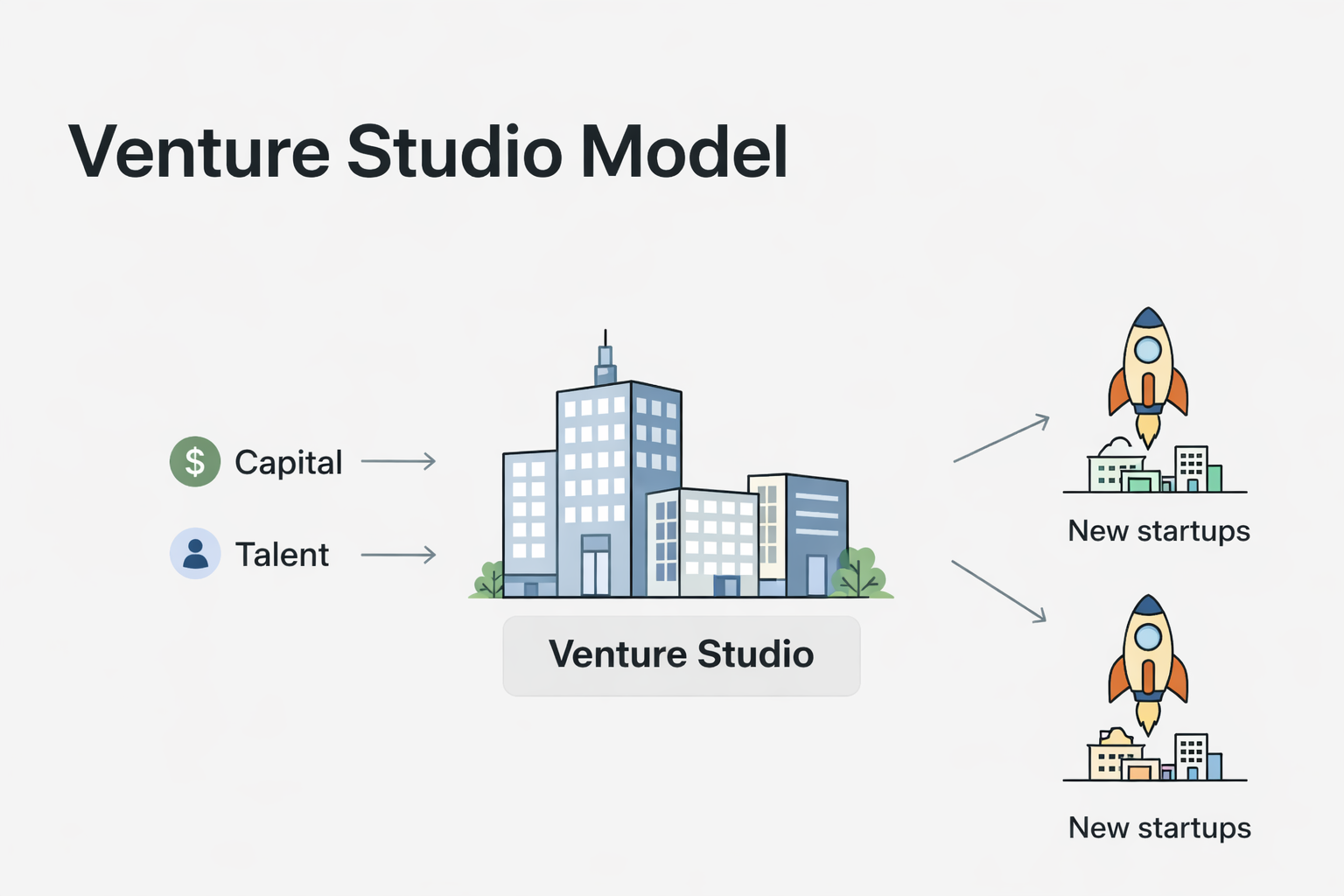
Venture studios are having a moment.
They’ve been around for years, but only recently have they started getting real attention from venture capital investors. Part of that is because the early-stage landscape has become more competitive. Part of it is because studios are starting to produce companies that look different from traditional startups.
At a basic level, a venture studio builds companies from scratch. But that definition undersells what’s actually happening.
As Matthew Burris puts it, “you’re playing the entrepreneurial role, the operator role, and the investor role.”
That combination is what makes the model interesting. And also why many VCs still struggle to evaluate it.
1. This Is Not an Accelerator Model
Studios are often grouped with accelerators or venture funds, but the comparison doesn’t really hold.
Accelerators support founders for a fixed period. Venture funds provide capital and guidance. Studios go much deeper. They are involved before the company even exists and stay involved well after it starts operating.
They don’t just back founders. They help create the conditions in which those founders operate.
That distinction matters. By the time a studio-backed company reaches a VC, a lot of the early chaos has already been worked through.
2. The Model Only Works if All Three Roles Are Real
A lot of confusion around studios comes from how loosely the term is used.
Some firms call themselves studios but are effectively service providers. Others look more like funds with extra support.
The real version is stricter.
A true studio operates across three roles:
- It helps shape or originate ideas
- It actively builds and operates companies
- It invests capital and owns equity
“If you’re not playing all three, you’re not a studio,” Burris explains.
For investors, this is the first filter. Not all studios are actually studios.
3. Founder Matching Is Where Things Break
On paper, the model sounds efficient. Generate ideas, validate them, and then plug in a strong founder.
In reality, this is one of the hardest parts.
Once an idea is clearly defined, the number of people who both understand it and want to build it becomes very small. Studios often find themselves searching for a very specific profile.
“The pool of ideal candidates shrinks… it’s really hard,” Burris notes.
That’s why many studios have moved toward bringing founders in earlier, before the idea is fully locked in. It leads to better alignment and stronger ownership, even if it makes the process messier.
4. Speed Is the Real Product
The most obvious advantage of studios is speed, but it’s easy to misunderstand where that comes from.
It’s not just about having capital ready. It’s about removing friction across the entire early stage.
Instead of spending months figuring out hiring, product, or go-to-market from scratch, founders are stepping into an environment where a lot of that thinking already exists.
As Burris puts it, “you get to move so much faster.”
For VCs, this means early-stage companies may look more polished than expected. The question then becomes how much of that is the founder versus the system around them.
5. The Cap Table Debate Is More About Perception
One of the most common pushbacks from VCs is around ownership.
Studios often take a significant equity stake, which can make the cap table look heavy at first glance. That leads to concerns about whether founders are sufficiently incentivized.
“You’re an investor… why are you taking so much equity?” is a reaction Burris hears often.
But this framing misses some context.
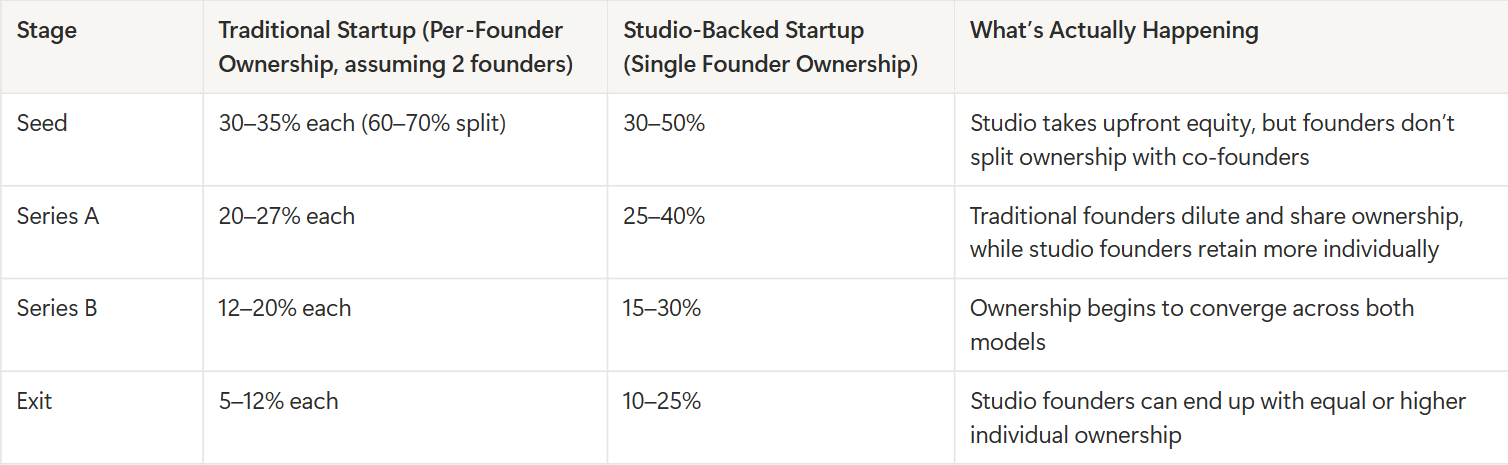
Studio-backed founders frequently avoid early dilution events. They don’t need to assemble multiple co-founders or raise small, incremental rounds just to get started. In some cases, their ownership ends up being comparable to traditional founders.
The structure looks different. The outcome isn’t always worse.
How Ownership Evolves: Traditional vs. Studio-Backed
6. Follow-On Capital Is Still Catching Up
Even with better-prepared companies, studios still face skepticism when it comes to follow-on funding.
A lot of VCs are simply not used to underwriting this model. There’s uncertainty around governance, decision-making, and how independent the founder really is.
That hesitation shows up in early conversations.
But it tends to fade with exposure.
Firms that have already backed studio-built companies are generally more open to doing it again. The companies are often more structured, clearer in their positioning, and further along than typical early-stage startups.
The barrier here is not performance. It’s familiarity.
7. Studios Are Becoming Part of Deal Flow
What’s starting to change is how VCs interact with studios.
Instead of only seeing them as a source of companies, some funds are beginning to treat them as partners in creation.
In certain cases, investors are approaching studios with specific ideas or gaps they want to see filled.
“We’ve been looking for a company that does this… can you go build it?” is a dynamic Burris highlights.
That’s a shift.
It moves venture capital slightly upstream, closer to company formation rather than just company selection.
8. Not Every Studio Is Optimized for Venture Outcomes
One nuance that often gets missed is that not all studios are playing the same game.
Some are fully aligned with venture-scale outcomes. Others are more flexible, building companies that may be profitable but not necessarily unicorns.
That flexibility can be a strength, but it also means VCs need to understand what a given studio is optimizing for.
If the incentives are not aligned, the partnership can break down later.
9. What You’re Really Betting On
At some level, investing in a studio-backed company is different from investing in a traditional startup.
You’re still backing a founder and a market.
But you’re also, implicitly, backing a system.
The processes, the playbooks, the way companies are built inside that studio all start to matter. Over time, studios that build repeatedly tend to get better not because they find better ideas, but because their systems improve.
That’s the real shift.
10. Notable Venture Studios to Know
As the model gains traction, a number of venture studios have emerged with distinct approaches to company building.
For investors, it is useful to understand how different studios operate, as their strategies, ownership models, and outcomes can vary significantly.
A few well-known examples:
Final Thought: How VCs Should Approach Venture Studios
Venture studios require a slightly different lens.
You’re not just evaluating a founder and a market. You’re also evaluating the system that helped build the company.
That changes how you should approach them.
- Spend time understanding the studio, not just the startup.
- Separate what the founder owns from what the studio enabled.
- Don’t dismiss the cap table at first glance.
- And build direct relationships with studios, not just their portfolio.
Most hesitation around studios comes from unfamiliarity.
The VCs who take the time to understand the model now will have an edge as it becomes more common.
Because the upside is not just one company.
It’s access to a system that can produce winners repeatedly.